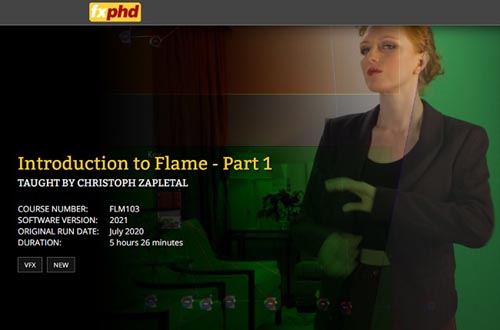
FXPHD - FLM103 - Introduction to Flame - Part 1

Admin 15-Aug-20 392 0 Print
Related Articles
[Tutorials] FXPHD : NUK232 Commercials Finishing for Boutiques
On 14-May-16 by
FXPHD : NUK232 Commercials Finishing for Boutiques | 12.3 GB...
?3DMax] VrayArt VRay Exterior Training Models and work files only
On 04-Jul-15 by
VrayArt VRay Exterior Training Models and work files only max | 3D models |...
[Tutorials] FXPHD - NUK229 Hit the Ground Running with NUKE Studio
On 28-Apr-15 by
FXPHD - NUK229 Hit the Ground Running with NUKE Studio Software: NUKE Studio |...
[Tutorials] FXPHD : NUK234 Immersive VR Compositing in Nuke
On 17-May-16 by
FXPHD : NUK234 Immersive VR Compositing in Nuke | 18.3GB...
[Tutorials] Digital Tutors - Compositing a 3D Architectural Rendering in Photoshop and 3ds Max - rep...
On 16-Aug-16 by
Digital Tutors – Compositing a 3D Architectural Rendering in Photoshop and 3ds...
[Tutorials] Digital Tutors - Compositing a 3D Architectural Rendering in Photoshop and 3ds Max
On 05-May-16 by
Digital Tutors – Compositing a 3D Architectural Rendering in Photoshop and 3ds...
The Foundry Nuke Studio 11.3v2 Win
On 17-Feb-19 by
The Foundry Nuke Studio 11.3v2 Win...
FXPHD - FLM103 - Introduction to Flame - Part 1
FXPHD ? FLM103 ? Introduction to Flame ? Part 1
Duration 5h 26m Project Files Included MP4
You must login to show this link. No account? Create One
Info:
Flame has the reputation of a mystery box. While widely used in the realm of commercials and advertising for everything from editing, vfx, grading to finishing, it has the perception to have a steep learning curve.
This course aims to demystify Flame and provide a solid foundation in all the different areas in which Flame can be used. Starting with media management and editing, you?ll quickly dive into the rabbit hole of node-based compositing, utilizing many tools unique to Flame.
With a balance between technical background and hands-on work, this course will introduce you to tools inside of flame that can seem overwhelming at first, but by taking it step by step you will soon be able to master this great tool. Flame for Mac OS is available on the fxphd VPN so you can follow along with the course.
Christoph Zapletal is a Freelance Flame and Nuke Artist and has been working in the industry for a little over twenty years. One of his specialities is beauty work and retouching. Beyond that, he is an Instructor at SAE Institute and a frequent contributor to Digital Production Magazine.
CLASS 1: INTRODUCTION
After a brief introduction to mandatory and optional equipment, we take a brief look at the rich history of Flame. Following that, we finally start to dip our toes into Flame by taking a tour of the interface, focusing on both the viewer and the desktop.
CLASS 2: EDITING
Flame offers both gestural and track-based editing. We?ll take a look at both techniques and also setup the desktop to resemble a more familiar NLE working enviroment.
CLASS 3: TRACKS, VERSIONS AND CONFORMING
Let?s add some more tracks to our timeline and also learn what differentiates Tracks from Versions. A close look into the FX Ribbon is also on the table as is a guide to conforming sequences from third party NLE?s
CLASS 4: COLOUR CORRECTION AND BATCH FX
An in-depth look at both the classic Colour cCorrector as well as the Colour Warper. After that we transition our effects from the timeline into Batch FX to take full advantage of Flame?s node based compositing environment.
CLASS 5: IMPORT, COLOUR MANAGEMENT AND ANIMATION
The days of dealing with a single colour space are over, so we take a good look on how to manage different colour spaces in your timeline. You?ll also learn how to correctly import file formats like PSDs or OpenEXR. Finally, some fun with animating some titles.
CLASS 6: KEYING SHOT, PART 1
Moving to the Batch tab, you?ll begin keying a shot using Flame?s Master Keyer and also explore the concepts of Batch Groups and BFX Clips.
CLASS 7: KEYING SHOT, PART 2
Refining the edges of the key for a better result. An exploration of the concept of iterations, followed by a deep-dive into tracking inside Action and the GMask Tracer.
CLASS 8: KEYING SHOT, PART 3
With the matte complete, a switch over to despilling, colour correction and edge treatment. After a brief stop in the paint node, we finish things off by adding a subtle light wrap to our talent. Along the way we explore the render node and how Flame manages rendered media.
Category: Other 3D
Add Comment