
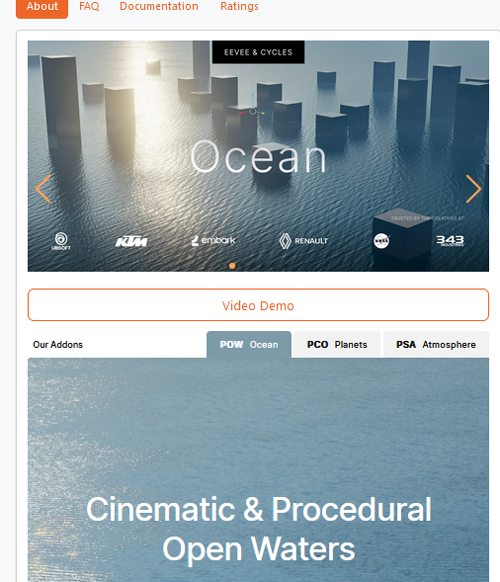
Physical Open Waters
Related Articles
MEGA BLENDER COLECTION-16-3-2024
On 16-Mar-24
by
INCLUDE: Hair Brick Pro for Blender v2.1 Retopoflow for Blender v3.4.3 Drag...
INCLUDE: Hair Brick Pro for Blender v2.1 Retopoflow for Blender v3.4.3 Drag...
Mastering CGI - Material and Brush Collection
On 18-Dec-17
by
Mastering CGI ? Material and Brush Collection...
Mastering CGI ? Material and Brush Collection...
Evermotion Archmodels vol 124
On 22-May-16
by
Evermotion Archmodels vol 124 c4d | obj | fbx | max | 3D models | 15.6 GB...
Evermotion Archmodels vol 124 c4d | obj | fbx | max | 3D models | 15.6 GB...
?3DMax] VrayArt VRay Exterior Training Models and work files only
On 04-Jul-15
by
VrayArt VRay Exterior Training Models and work files only max | 3D models |...
VrayArt VRay Exterior Training Models and work files only max | 3D models |...
Plugin - Houdini 16.0.504.20 Win x64
On 17-Mar-17
by
Houdini 16.0.504.20 Win x64...
Houdini 16.0.504.20 Win x64...
Elven Strapped Bundle
On 25-Dec-21
by
Elven Strapped Bundle...
Elven Strapped Bundle...
[3DMax] Gnomon Workshop Texture Library Bundle
On 02-Aug-15
by
Gnomon Workshop Texture Library Bundle JPEG | TIFF | Textures | 37.2 GB...
Gnomon Workshop Texture Library Bundle JPEG | TIFF | Textures | 37.2 GB...
Implementation
Vertex Shader
For altering the vertices of a water mesh to simulate wave movement, using the Gerstner equation to displace vertices.
Fragment Shader
For computing lighting, reflection, refraction, and shading details. This involves using normal mapping for small ripples, specular mapping for shiny water effects, and possibly shadow mapping if the water receives or casts shadows.
Procedural Generation
Open waters in a large environment are often procedurally generated to avoid the memory cost of large textures. Noise functions like Perlin or Simplex noise can generate the base pattern for the water surface. These patterns can be tiled and offset over time to simulate continuous motion.
Performance
Real-time performance requires careful consideration of computational cost. Level of detail (LOD) systems can reduce the number of calculations by simplifying the water simulation at distances. Simpler mathematical models may be used for distant water, while closer water requires more detailed simulation.
Interactions
Simulating interactions with other objects, like boats or characters, adds another layer of complexity. This involves dynamic modification of the water's surface and appropriate response in the shader, which can be simulated with render targets that allow shaders to write and read interaction data.
Environmental Effects
Water appearance changes with weather conditions and time of day. Shaders must adapt to different lighting conditions, and possibly integrate with particle systems for effects like foam and splashes.
Optimization
Techniques such as culling, where non-visible water surfaces are not processed, and using lower precision arithmetic where possible, can help maintain performance. Additionally, shaders can be written to take advantage of parallel processing capabilities of modern GPUs.
Product ID: Physical-Open-Waters-v1.2.1
Detail Link: https://blendermarket.com/products/physical-open-waters
DOWNLOADYou must login to show this link. No account? Create One
Category: Daz & Poser
Detail Link: https://blendermarket.com/products/physical-open-waters
DOWNLOADYou must login to show this link. No account? Create One